The Incremental Escape: How Mid-Market Companies Are Modernizing Legacy Systems Without Betting the Business
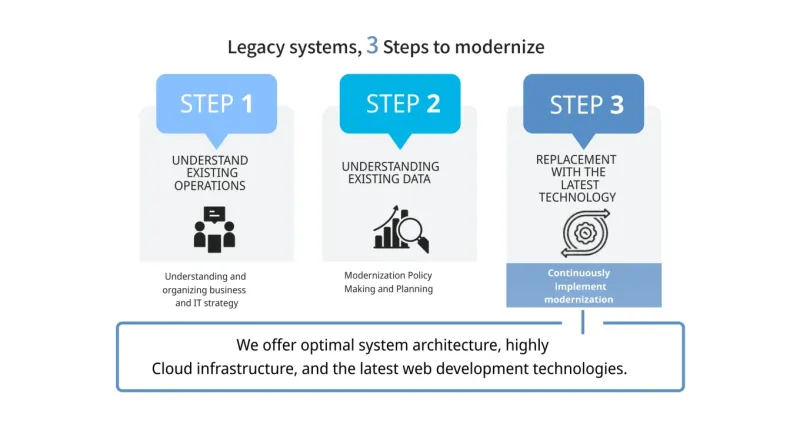
Photo: software modernization legacy system migration technology team office, via thinkbiz.co.in
The All-or-Nothing Trap
Picture a regional distribution company operating out of Columbus, Ohio. Its warehouse management system was implemented in 2009. The software vendor stopped issuing security patches three years ago. The development team that originally built the customizations has long since moved on, and the institutional knowledge of how the system actually behaves lives primarily in the heads of two employees who are both eligible for retirement. Leadership knows the platform needs to go. But every time a modernization proposal reaches the budget committee, the conversation ends the same way: the projected cost is too high, the timeline is too long, and the risk of disrupting daily operations is simply too great to accept.
This scenario plays out in mid-market enterprises across the United States with remarkable regularity. The platforms are different — aging ERP systems, homegrown CRMs, on-premise telephony infrastructure, first-generation e-commerce engines — but the organizational paralysis is nearly identical. Companies are not failing to recognize the problem. They are failing to find an entry point that does not feel like a bet-the-business decision.
The good news is that a growing body of real-world evidence suggests there is a third path between doing nothing and doing everything at once.
Why Rip-and-Replace Fails More Often Than It Succeeds
The appeal of a comprehensive platform replacement is understandable. A single, well-executed migration delivers a clean break from technical debt, a unified modern architecture, and the ability to tell a straightforward story to investors, customers, and employees. The problem is that large-scale IT transformations fail at a rate that should give any executive pause.
Research from McKinsey and others consistently finds that major technology transformation projects run over budget and over schedule at rates exceeding 70 percent, with a meaningful percentage delivering substantially less value than projected. For mid-market companies without the cash reserves of an enterprise-scale organization, a failed transformation is not just a setback — it can be an existential threat.
The failure modes are well-documented: scope creep, data migration complexity, underestimated integration dependencies, staff resistance, and the near-universal tendency for legacy systems to contain undocumented business logic that only becomes visible when it stops working. A rip-and-replace project that looked clean on the architecture diagram encounters the real system and discovers it has been quietly managing exceptions, workarounds, and edge cases that nobody thought to document because nobody thought they mattered.
The Parallel-Run Alternative
Incremental modernization — sometimes called strangler fig architecture in software engineering circles, after the vine that gradually replaces its host tree — operates on a fundamentally different premise. Rather than replacing the legacy system in a single cutover event, the organization builds modern capabilities alongside the existing platform, migrating functions progressively while keeping the legacy system operational as a safety net.
The approach typically follows a recognizable pattern. First, the organization maps its legacy system's functions into categories: core business-critical processes, high-frequency but lower-risk workflows, reporting and analytics functions, and integration points with external systems. Second, it identifies the functions that can be migrated first with minimal disruption — often reporting layers, customer-facing interfaces, or peripheral workflows that are technically dependent on the legacy system but not operationally inseparable from it. Third, it builds or deploys modern replacements for those functions, runs them in parallel with the legacy system long enough to validate parity, and then formally cuts over.
Each successful migration reduces the legacy system's footprint, lowers the overall transformation risk, and generates organizational confidence that the process works. Over time — typically 18 to 36 months for a mid-market deployment — the legacy system is reduced to a residual core that is far easier to replace than the original monolith.
Real Outcomes From the Field
A specialty manufacturer in the Southeast recently completed a three-year incremental migration away from a legacy ERP system that had been in place since the mid-2000s. Rather than replacing the core system immediately, the company began by building a modern data warehouse and BI layer that pulled from the legacy ERP via API. This gave the business modern analytics capabilities — dashboards, real-time inventory visibility, predictive demand modeling — without touching the transactional system at all.
With the analytics layer stabilized and the team's confidence in the integration architecture established, the company migrated its procurement workflows to a cloud-based platform, again running in parallel for a full quarter before cutting over. The legacy ERP continued handling order management and financials throughout. By the time the company was ready to replace those final core functions, the team had accumulated 30 months of migration experience, the integration patterns were well understood, and the business had already captured a significant portion of the expected modernization value.
Total project cost came in at roughly 40 percent below the original rip-and-replace estimate. More importantly, the company experienced zero operational disruptions that affected customer delivery commitments throughout the entire three-year window.
The Cost and Competitive Case
Beyond risk reduction, incremental modernization offers a financial profile that is considerably more attractive to mid-market CFOs than a large-scale transformation. Capital expenditure is distributed across multiple budget cycles rather than concentrated in a single year. Each phase can be evaluated independently, giving leadership the option to pause, accelerate, or reprioritize based on business conditions. And because value is delivered progressively — better reporting in year one, improved customer workflows in year two, modernized core systems in year three — the business case does not depend on a single future payoff that may or may not materialize.
There is also a competitive dimension that is easy to overlook. Mid-market companies that successfully modernize incrementally build internal capabilities — in integration architecture, cloud operations, data engineering — that become durable organizational assets. Teams that have navigated three or four successful migration phases develop the confidence and expertise to continue modernizing as technology evolves, rather than accumulating new technical debt on top of the old.
What a Phased Modernization Strategy Requires
Incremental modernization is not without its own demands. It requires sustained executive commitment over a multi-year horizon — the kind of organizational patience that is sometimes harder to maintain than a single high-urgency transformation sprint. It requires disciplined dependency mapping at the outset, so that the migration sequence is driven by technical logic rather than political convenience. And it requires investment in integration infrastructure — APIs, data pipelines, identity management — that serves as the connective tissue between old and new systems during the transition period.
At 3SS3 Tech, we help mid-market organizations build the architectural roadmaps and integration frameworks that make phased modernization viable. The path from legacy limbo to a modern, competitive stack is rarely a single leap. For most businesses, it is a series of deliberate steps — each one smaller than the full transformation, and each one more certain to land.